31/08/2026 0 Comments
Bread for the World: Sermon series on the Lord's Prayer
Bread for the World: Sermon series on the Lord's Prayer
# Sermons
Bread for the World: Sermon series on the Lord's Prayer
Praying for 'daily bread' focuses on the necessities of life and challenges us to be part of God's provision. Andrew M looks at two examples of the needs in front of us, and the needs hidden from our view are met through the work of the Grace Pot and Medair, and challenges us to consider the place for receiving as well as giving, from a lesson learnt from plates in Thailand. This sermon was first preached as part of the Lord's Prayer sermon series at St Denys Church.
We are now moving to episode 4 in our series on the Lord’s Prayer, and today it starts getting practical. Today I have just five words – give us our daily bread. They are in one sense simple to understand, but they are also deep in their implications.
This simple request isn’t about politeness and is not showy, but demonstrates reverence and expectation. It shows an attitude of dependence and of yearning for others. God knows our hearts and doesn’t need our prayers to be dressed up! Remember, this is how Jesus taught his followers to pray … Our creator God is a loving Father, who knows what we need, delights in answering prayers and we can depend on him … and express this in our prayers.
The Necessities of Life
Two weeks ago we were reminded us that the Lord’s Prayer is a collective prayer - our Father, not my Father; our daily bread, not my daily bread; forgive our sins, not forgive my sins … and so on. So asking for daily bread is not primarily about our personal needs, but our collective needs – within our families, our church, our communities and further afield. And it is about something that is very basic and fundamental, so much so that the early commentators could not believe that after three opening, lofty, noble petitions relating to God’s glory, that we should abruptly descend to something as mundane and material as concern for our daily food.
The early church fathers like Turtullian, Cyprian and Augustine thought the reference was to either the invisible bread of the Word of God, or to the Lord’s Supper. When the reformers came along, they had a more down-to-earth, biblical understanding. Calvin described over-spiritualising on this as ‘exceedingly absurd’, and Luther had the wisdom to see that ‘bread’ was a symbol for everything necessary for the preservation of this life, like food, shelter, family, and so on.
Give us our daily bread – not give us chocolate on a daily basis! We are talking here about the necessities of life. And I have three quite practical examples of what this prayer means that I want to briefly share with you today.
Now I know that for some in our community, life is tough and many of the basics in life are hard to come by and sometimes missing. This prayer is deeply personal, offered to a loving heavenly father who cares for us and longs to give good gifts. Jesus saw physical needs, and when the 5,000 were hungry after listening to him all day, he provided the food they needed. It is sometimes in the gift of others to be prompted by God and to be the answer to that prayer for daily bread. Jesus called for a response from his disciples and included them in the solution. The apostle Paul was upfront about raising money for the care of the poor and the widows from the more wealthy churches as he went about visiting and encouraging the Christian
I like the simpleness of Proverbs 30:8 “…Give me neither poverty nor riches, but give me only my daily bread.”
The needs we know of and the needs we see around us are the daily bread we ask for, and we can share in God’s answer to this prayer. I sat down with Marion last week to work out how many cups of tea/coffee are served up every year at St Denys and we came up with 14,000. You could do the same maths for food given out, meals provided, shelter offered, friendship given.
Example #1 The Grace Pot - responding to the needs we see
There is one other way in which we respond to needs we see which I want to share again with you today. We have something called the Grace Pot, which is money from the church set aside to meet the emergency and crisis needs of some of the people who come our way, mainly those who we have started to build relationships with. On our behalf, Sera and Paul offer help to some of these people, in the name of Jesus. Recent examples include: a pair of shoes in the winter for someone whose only shoes had holes, bandages to be used for dressings, a bus fare, money to top up electricity, some clothing for a job interview. Small amounts, everyday things that most of us take for granted, but needs that we were able to help with.
The money set aside for this year has already been just about used up, so this week we have set the offering card reader at the back of the church to the Grace Pot, so if you are able and want to give some money to top up the Pot, please do! (or do this online Giving | St Denys Church & Centre)
Example 2: Medair - responding to the needs we do not see
Secondly, there are needs we are not so closely involved with across the world, and we can include some of these in our prayers. Medair, one of our mission partners who we support financially, go that final part of the way to meet needs of people in remote, often war-torn areas, and they do this in the name of Jesus and on our behalf. Matt Hyam who worships at St Deny is their church engagement lead and is always happy to explain more about what they do.
They provide rapid humanitarian emergency assistance through their globally deployable response team. Their core life-saving interventions include urgent medical and nutritional care, safe drinking water and hygiene support, emergency shelter solutions, mental health care, and essential basic living items for crisis-affected populations. Here is one recent example of the amazing work they do (Every second counts when lives are on the line):
10 month old baby Jok Jok was brought to one of Medair's nutrition stabilisation centres in South Sudan - she faced life-threatening levels of malnutrition. She was urgently given a special baby formula called F-100, which was the vital help she needed to start on the road to recovery.
Her mother Kabacha said: "Medair has helped my child become well. She’s playing with the other children now and each day, they’re all getting better. I will tell my community to come to the clinic for help - I know this is a good place, you have saved my child”.
Medair are doing this in Jesus’ name and on our behalf.
The Lesson from Plates
The needs we see, the needs we do not see and finally, the importance of paying attention to what God is saying to us through the people and places around us … and the reciprocal nature of community life. I want to share with you a story in CMS magazine that beautifully illustrates this.
Elise and Jon Fletcher live in Khlong Toei, Thailand’s biggest slum community, where 100,000 people are living in material poverty, unaware of their God-given worth. Elise writes:
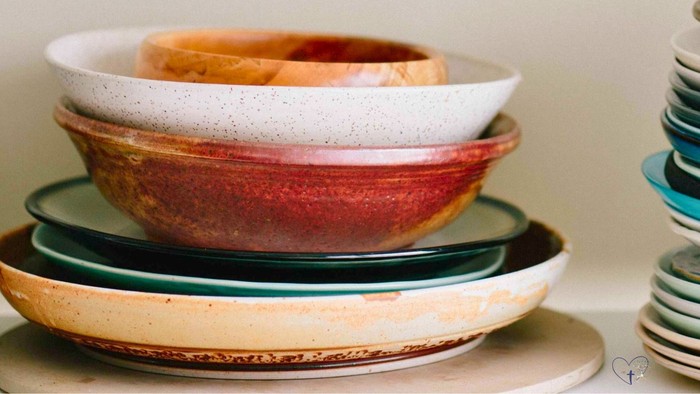
'When we first moved to Thailand, we inherited a collection of odd plates. They were perfectly functional, if slightly garish, but we made do. After a year or so we found ourselves feeling homesick in IKEA and caved in to buying a matching set – plain blue, not plastic!
Once we were more settled into the community, we began to receive gifts of food. If a neighbour was cooking something good, they would bring over a plateful so we could enjoy it too! Though we didn’t dare compete with samples of our Thai cooking, we soon learned who appreciated our occasional baked offerings! One thing niggled. People didn’t return the plates… and they seemed shifty when I returned theirs! I bought a stack of paper plates to get around this problem and let the donated plates stack up by the front door for neighbours to take back if they wanted them. We still had eight of the 12 matching plates so all was well…
Then, one day I handed a plate back to a friend who feigned shock that it was empty… it was a lightbulb moment as I realised where I had been going wrong. I had underestimated the reciprocal nature of community life. Not that people wanted anything in return, but that it was natural to give out of whatever we had, whether that be a few bananas from a bunch or the excess rice that would go to waste. This could be an everyday thing, not just a grand gesture when we baked brownies.
A few weeks ago, I commented on the delicious smell of a soup cooking in a clay pot outside the home of a new neighbour. We hadn’t talked before but I learned that she had moved here from the countryside to cook and clean for two grown-up sons. As I drove away, I suspected I’d be tasting that soup later in the day. Sure enough, my new neighbour appeared at the door with a bowl later that morning. She wasn’t home when I returned it filled it with lamyan fruit so I left it on her outdoor cabinet.
That bowl has moved back and forth every few days (changing colour occasionally, as I’ve learned that the specific plate is not what matters!) Though we’ve not exchanged many words, my new neighbour and I have bonded over shared food. As I passed her house the other day she had a suitcase packed and told me that she is going to care for her sister who is very sick. Every time I see her plate in our cupboard, I am reminded to pray.
We are now down to four matching plates that get used most days. But they are mixed in with ten or so randoms, which I’ve learned is exactly how it should be; we are right back where we started! As plates circulate between houses, I’m reminded of how much we need others and how diversity makes life richer. Though there are certainly members of our community excluded from the circle of reciprocity, by participating we can help to expand its scope and reach.'
“Life is not a possession to be defended, but a gift to be shared” Henri Nouwen
Praying to Be Part of God's Bread-For-The-World Agenda
I am not a naturally creative person, so when Paul got us to start putting the Lord’s Prayer into our own words two weeks ago, I struggled. Last week we were treated to Robert’s beautifully crafted, expanded version and blessed by it. I want to finish this morning with a re-telling that I came across last week by Bishop Tom Wright in his book Simply Christian. I like it because it is simply stated and not embellished … and gets to the heart of each word and phrase. This is how he puts it:
‘I want to be part of his kingdom movement. I find myself drawn into his heaven-on-earth way of living. I want to be part of his bread-for-the-world agenda, for myself and for others. I need forgiveness for myself – from sin, from debt, from every weight around my neck – and I intend to live with forgiveness in my heart in my own dealings with others. And because I live in the real world, where evil is still powerful. I need protecting and rescuing. And through it all, I acknowledge and celebrate the Father’s kingdom, power and glory’.
It’s remarkable, isn’t it, when we look at it this way, that at the heart of the prayer, we commit ourselves to live in a particular way, a way we find difficult!
So let us be part of his “bread for the world” agenda, for ourselves and for others, … and let us learn from being in community and holding lightly to things we have, may we continue to be part of God’s answer to the prayer Give us today our daily bread!

Comments