22/04/2026 0 Comments
Pain Transformed: reflections on Thomas and Jesus in John 20:24-29
Pain Transformed: reflections on Thomas and Jesus in John 20:24-29
# Sermons
Pain Transformed: reflections on Thomas and Jesus in John 20:24-29
Sera invites us to explore Thomas' response to the news that 'Jesus is alive' from the perspective of his pain, and to see how Jesus, through his own scars, transforms Thomas' pain and our own. This was first preached as a sermon as St Denys in April 2026.
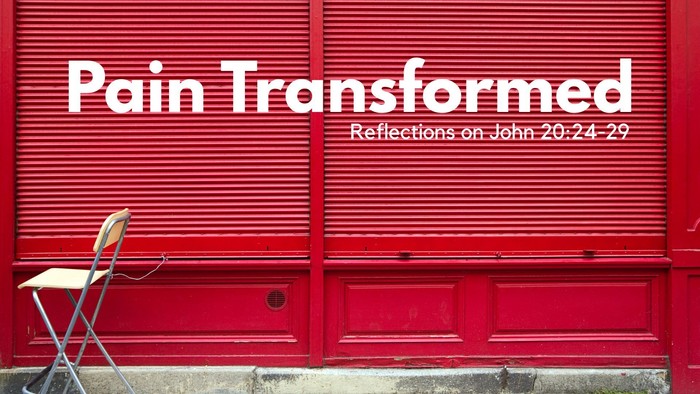
Shutters Down
Think of a time when you have been in physical pain: a stubbed toe, a piercing headache, recovering from surgery. In that state of pain, did it feel like the shutters came down; That you were unable to focus on bigger things or to be open-minded? Your world got smaller and the pain filled your vision.
This doesn't just happen with physical pain, but also with other forms of pain too: like grief, loss, disappointment, rejection, disillusionment, failure.
In today's passage we see pain confronted, not avoided. And we see it’s not the end of the story.
Not There
The events described are a week after the startling news that Jesus is alive. He was dead. And yet the tomb is empty, he’s appeared to some of his friends and followers, but not all.
Not Thomas. Thomas was not with the others when Jesus joined them in the locked room, when he declared peace into the disrupted and broken lives, and set them on a post-resurrection journey.
Thomas was not there. We’re not told why. For a while I’d assumed he was doing an errand or something. He’d missed out on the action accidentally, while he was shopping for vegetables!
Pain
But there have been some reflections by Eugene Peterson and Nadia B-W that offer a different light on this:
Maybe the pain was too great.
Maybe Thomas wasn’t there in the room, because he wasn’t following Jesus anymore. And he had given up.
Maybe he thought that following Jesus was over and done with. He had followed Jesus to Jerusalem, he had taken the risk and made the sacrifice, but the nails had gone into Jesus’s side and the spear had ripped his side. And Thomas had concluded it was all over.
Maybe the pain of Judas betrayal, the violence, the murder, the crowd, the darkness, the shame and the end of the story was just too great.
Maybe Thomas wasn’t in the room with all the other guys, because in the midst of this pain, he wanted to be alone. Pain so often isolates us doesn’t it. The shutters were down.
‘Unless I see the nail marks in his hands and put my finger where the nails were, and put my hand into his side, I will not believe.’ v 25
The language used in this passage implies adamant and active and defiant ‘not believing’ and I am compelled to see that pain had something to do with this. This is the pain of disappointment, of violence, of shattered hopes, of betrayal, of lost purpose. And so Thomas isolates himself. And Thomas shuts himself down. I will not believe… ‘unless’.
I wonder if you can identify with this at all. It might not be so brutal and sudden, but I wonder where pain has meant that you close the door and pull the shutters down. Maybe these are some reasons we can identify with at times for not following, or not following anymore- Thomas is ‘A Twin’ – are we his twin sibling?
Enough
I love it that even in the depths of pain there are glimmers of light – where there is enough of something to mean that the door is not totally shut.
Firstly there is the ‘unless’ – there is something that will convince Thomas – does he expect to get it? Maybe, maybe not. But atleast the door is ajar, the shutters are not totally down.
Secondly there is the fact he is willing to meet with the others again – he steps back from his isolation, and steps into the company of others. They cannot convince him that Jesus is alive, but they can keep including him, and make him welcome in a space where he might encounter Jesus.
These things are enough.
I wonder if you’ve ever been frustrated that someone else is not agreeing with you, or believing what you believe even though you’ve tried so hard to convince them, and you believe it so strongly.
Take heart. Maybe the best thing you can do is make a person feel welcome so that they keep on turning up and not isolating themselves. The rest is on Jesus.
Encounter
And so one whole week later, which can feel like a life time when you’re in the midst of pain, when you feel everyone else is on something that you really can’t be part of, Thomas is in the room this time.
The doors are locked, because things aren’t rosy for any of them – they in the heart of political, military and religious might and power – and they are the followers of the trouble-maker who has now gone missing. It’s not a safe place to be for them.
‘A week later his disciples were in the house again, and Thomas was with them. Though the doors were locked, Jesus came and stood among them and said, ‘Peace be with you!’ (vs 26)
An echo of the week before: locked doors are not a barrier to the resurrected Jesus meeting with them, the stumbling nature of their discipleship is no block to the pouring out of Shalom – deep peace.
This time, Thomas is here. And in the midst of the company of others, Jesus ministers to Thomas personally. That is such the way of Jesus – collective and individual held together in balance.
‘Then he said to Thomas, ‘Put your finger here; see my hands. Reach out your hand and put it into my side. Stop doubting and believe.’ (vs 27)
There are a few things we can notice about the resurrected Jesus:
- that somehow he can move through locked doors, whilst also being fully physical and touchable;
- that he knows without Thomas telling him what evidence Thomas is wanting;
- that somehow he balances meeting a need with giving a kick up the backside ‘Stop doubting and believe’.
- that he fully tunes in to the person in front of him, while also speaking to those who will come later (Like me and you): Then Jesus told him, ‘Because you have seen me, you have believed; blessed are those who have not seen and yet have believed.’ (vs 29)
Scars
But the thing I want to focus in on is the scars. Of all the things that could provide evidence that this is really Jesus, it is the scars that speak.
- These scars speak of the pain that Jesus went through – being nailed to the cross, being pierced in the side by a sword. Pain was not avoided. It was chosen and embraced.
- The scars tell of the truth – you didn’t imagine the events of the cross, they really happened.
- They are the evidence that the same body that died is the body that stands before you now, there is not trick or magic.
- These scars are now on a living breathing resurrected Jesus. They are not the end of the story.
So these scars speak of a pain that is fully known, and that was journeyed through, and defeated. They are not to be hidden nor are they to be removed from the resurrected body of Jesus – they are not be ashamed of, for they are not the end of the story.
A Thomas in pain, meets a Jesus who knew pain, and he makes the declaration that is the culmination of all declarations on John’s Gospel:
My Lord (who I will obey) and My God (who I will worship) – (vs 28)
There is life beyond pain when you encounter the resurrected and scarred Jesus.
Someone Worth Believing In
This sermon is not about convincing you to believe, but to show you someone & something worth believing in.
With Jesus pain is not denied, but neither is it the end of the story. Keep the door open enough to encounter Jesus and see what he brings to you.
- To see that it is the resurrected, scarred Jesus who deals with your pain.
- To avoid isolating yourself and to spend time in the company of those who are kind and who have encountered Jesus.
- To invite you to pray for those who have their shutters down and to make sure that they always feel they can and want to be with other friends and follower of Jesus
- To challenge you to respond to the resurrected Jesus with humility and worship, secure in the knowledge you are seen and known: my Lord and my God

Comments