09/07/2026 0 Comments
Guide to Sunday Services 'Worship Ministry' - info for communion, reading, prayer, music, kids groups, leading, preaching, Mustard Seeds
Guide to Sunday Services 'Worship Ministry' - info for communion, reading, prayer, music, kids groups, leading, preaching, Mustard Seeds
# Guides
Guide to Sunday Services 'Worship Ministry' - info for communion, reading, prayer, music, kids groups, leading, preaching, Mustard Seeds
Worship Ministry: Practical Help and Guidance for Doing the Tasks
Purpose of Worship Ministry: Eugene Peterson’s paints a great picture of Sunday worship: ‘We listen to God’s Word read and preached, and once again get our story straight; we receive the life of salvation eating and drinking the Lord’s supper…and recover our Jesus focus; we find ourselves in the singing and the giving thanks, in the greetings and the prayers, freshly renewed by the Spirit to practice the resurrection in the company of the Trinity.’ As part of Worship Ministry, we participate with God in helping this happen.
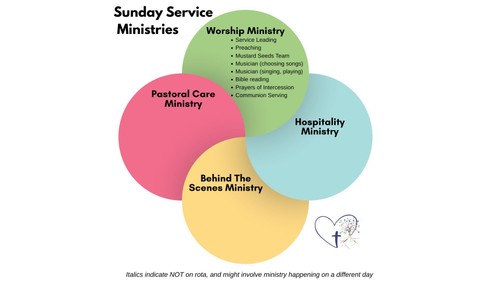
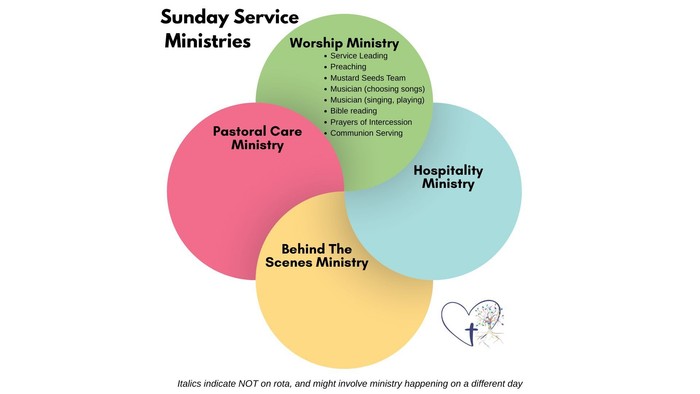
Roles included: Communion Serving; Prayers of Intercession; Bible reading; Musician (choosing songs, and/or playing music or singing); Mustard Seeds Team; Service Leading; Preaching
Helpful People to ask for more info: Sera, Paul, Sue (Resources), Alan (music),
An invitation to everyone: You are all encouraged to come and join with the time of prayer before the service, which is at 9.30 in The Den.
The Different Roles and Responsibilities:
Communion Cup Serving:
You are ministering to each member of the congregation who has responded to the invitation to come and receive from Christ.
Come to the Communion Table during the words of invitation (often ‘Draw near with faith’) so you are ready to start serving promptly.
Move along side by side with the other cup server, as much as possible, rather than overtaking each other.
Give the cup to the person to hold and drink from, and wipe it when it’s given back to you.
Kids who receive communion should only be offered the non-alcoholic cup.
If you run low on wine, try to top up from the silver jugs. If these are empty ask the Officiant to bless more wine.
Prayers of Intercession:
It is such a gift to a worshipping community when the words and silence of intercessory prayers help us to express something to God about personal, local or global needs that we were finding hard to put in words.
Remember God is the audience, and not the congregation (so you don’t need to give lots of information)
Total time for prayers of intercession should be 2 to 3 minutes. If you’re writing them in full, that’s probably 200 to 300 words
Prayer is woven throughout the whole service, it is a prayer-filled journey. The emphasis of the intercessory prayers is asking God for help.
Consider what particular themes and ideas you are drawn to focus on across personal, local, national and international scales (you don’t need to cover everything). Liasing with the leader and preacher can help, and definitely spend time contemplating the Bible passage.
Feel free to draw from a range of methods including silence, prayers written by someone else, the use of repeated phrases, carefully crafted words, or short, more extemporary prayer.
If you want the congregation to say a phrase within the prayer, always introduce it with the same phrase throughout the prayer, and ideally tell the Service Leader beforehand so it can be put on the slideshow (this way people can
Consider how you will have a clear ending to the prayers
Bible reading:
This responsibility is so important (as you are reading God’s word to God’s people) and an immense blessing when done clearly, loudly and with expression.
Therefore, familiarise yourself with the passage before you read it out loud.
The version used on the screen and in the Enews is currently the NIV (UK) version, so if you read this version it will closely match what’s on the screen.
You can read from a physical Bible, from a printout of the service plan or from your phone (Using the service plan or the Sunday enews for info)
Check in with the Service Leader before the service begins so they know you are here, and can confirm when the reading is due to happen (you’ll also have this information in the service plan sent a few days before)
Always announce where the reading is from at the beginning. And end with a clear statement such as ‘This is the word of the Lord’.
Musician (including the responsibility of choosing the songs)
Musical worship enables people to lift their souls, hearts, minds & (often but not always) their voices to express gratitude, praise and commitment to God. As part of this, it recalls the character and activity of God, in particular as revealed through Jesus Christ.
When choosing songs
Prayerfully read through the Bible passage, notice any themes or focus in the rota, and consider where we are at in the church calendar (eg Advent is a time of waiting, Lent is a time of repentance). Liaising with the Preacher and Service Leader is helpful.
Balance using older/familiar and newer/less familiar songs in any service, so that people can participate comfortably in at least part of the music worship.
Check that your fellow musician knows the song, or is able to learn them.
Inform both the Service Leader and Sue by the middle of week (ideally Tuesday morning)
For more modern songs, also tell the service leader and Sue by the middle of the week, the order of verses and chorus and if/where a Bridge is used.
By 9.45 on a Sunday, everything needs to be settled and sorted including practising the flow and links in songs, doing the sound check, checking the words on the Proclaim slideshow. From 9.45 the emphasis is upon music helping to prepare people for worship.
At the end of the service, please close the piano lid, and help leave the area as tidy as realistically possible.
Mustard Seeds Team (including helpers and leaders)
You have a particular ministry to helping younger members of the congregation experience the connection between their lives and God’s life, and to express gratitude, praise, concerns, creativity and any other response.
You must be DBS checked and have completed the Safer recruitment before helping or leading sessions.
Resources and planning material can be
Further information is available through the detailed role description available from Paul
Service Leading;
You are the guide that leads the people of God through the journey of worship within the Sunday Service, at times stepping into the foreground to steer, make connection or draw attention to certain things, at other times stepping aside for others. But you continue to steer and guide the whole journey, listening attentively to God and participants, equipped through the preparation you have done.
A service is not a lesson or a performance, it is a journey.
Planning bit:
Songs: When leading, one of the band members will choose songs. However, these are often sent as recommendations to the service leader and preacher to check whether they are OK or if they would like to suggest any changes. Therefore, send an email to the person choosing songs a week or so beforehand, to let them know you are leading and share any particular thoughts.
Planning sheet: We have a planning sheet available as a guide, do ask Paul or Sera. This is sent round to everyone at some point in the week before the service. Liaise with Paul and Sera who can help send this out.
Liturgy. Liturgy changes throughout the year according to the church season. During ordinary time, there are two liturgies used on alternate weeks. Also for the 10 am service, you do not need to do the creed, Gloria, or collect. You can also have a different refrain for the intercession and use a different confession, if you would prefer.
Focus Activity: After the first song, there is usually some form of engagement or activity that helps those present to integrate, or connect, their week with the service. This tries to break down the notion of church and life outside church as separate, so that we may bring the reality of our week (good and bad) as the starting place for our worship service. Ideally, this would also link with the theme of the service.
Slides: Slides are created by Sue normally on Friday morning. Therefore, if you have any images or words you would like displayed, you need to email Sue with the information before Friday.
Service bit:
People gather to pray at 9:30 am before the service. It would be helpful if you could make it.
Check with either Sera or Paul what notices there are and who is giving them.
The person on sound should come and find you and give you a radio mic to use.
Decide if you want to control moving the slides along with the 'clicker', or if you would prefer someone else to do that
Preaching:
Pray & listen to God – Give time in your preparation to delve into the depths of the passage and seek God in what he wants bringing to St Denys folk.
Length - Aim to be 10-15minutes – in terms of word count, I find this is about 900- 1200 words, but everyone is slightly different dependent on pacing. Normally, the Sermon should be ending around 9.40pm
A key decision in preaching is what NOT to say. Nadia Bolz-Weber reflected that background knowledge and exegesis is like underwear, it needs to be there but people don’t need to see it!
Be yourself – don’t feel there is one mould of preaching that everyone needs to fit into at St D – hopefully by now you’ve sussed out that everyone is different who preaches.
If you want a particular image of the projector then send it to Sera or Paul by Friday
Tread carefully around divisive issues such as party politics and sexuality – there are a wide range of opinions held in the church, and that diversity is a positive thing. Sermons are not the natural habitat for engaging in these issues (discussion groups are better forums), unless done really, really sensitively, compassionately and wisely with a good pastoral insight into the congregation. So I’d suggest that, whilst it is important to address current issues, you avoid addressing things like party politics and sexuality, unless it’s an obvious strand in the passage.
It’s helpful to let the service leader know something about theme you want to focus on before Friday – so that final planning can reflect this
What to wear? - you don’t need to dress formally, my basic rule of thumb is to not wear things that might distract or be a hurdle or barrier to people tuning into God eg- really ripped or dirty clothes, or slogans on t-shirt that say messages.

Comments